


Signs Business Needs Fiber Network Solutions Dubai

5 Critical Signs Business Needs Fiber Network Solutions Dubai
Signs business needs fiber network solutions Dubai usually show up gradually, not all at once. Most businesses don't plan a network upgrade — they get pushed into one. A video call that keeps freezing, a file transfer that takes twenty minutes instead of two, a new branch that can't get a stable connection between floors. On their own, these look like small annoyances. Together, they're usually the first signs that copper infrastructure has hit its limit. Here are the five signs Dubai businesses most often notice right before they move to fiber.
Quick Answer: The clearest signs business needs fiber network solutions Dubai are: recurring slowdowns during peak hours, frequent connectivity drops, moving into a larger or multi-floor space, growing dependence on cloud tools and video calls, and plans to add bandwidth-heavy systems like CCTV or access control. A typical upgrade includes a site survey, structured cabling, fusion splicing and OTDR-certified testing on every link.
1. Your Network Slows Down at Peak Hours
If your internet feels fine early in the morning but crawls by mid-afternoon once everyone's online, uploading files and joining calls at the same time, that's a bandwidth ceiling — not a one-off glitch. Copper connections share capacity in a way that becomes obvious the moment real load hits them.
This pattern is easy to dismiss as "just a busy day," but if it repeats on a predictable schedule, it means the network is already running at its limit during normal business hours — not just during an unusual spike.
It's also a sign that's easy to under-report internally, because staff tend to work around it rather than flag it — closing extra tabs, avoiding video calls during "the slow hours," or simply accepting that certain tasks take longer in the afternoon. That workaround culture is often the clearest evidence that the network, not the workflow, is the actual bottleneck — and it's one of the earliest signs business needs fiber network solutions Dubai wide.
2. You Get Frequent Connectivity Drops
Copper cabling degrades with distance, heat and interference from nearby electrical equipment — problems that get worse over time, not better. If your team regularly has to restart a router or reconnect a dropped call, especially in the same part of the office each time, that's usually a sign of a physical limitation, not a settings issue.
This kind of intermittent fault is also one of the hardest for an IT team to diagnose from software alone, because it often only shows up under specific conditions — heat during the afternoon, equipment switching on nearby, or heavier traffic at a particular time of day. Tracing it to a cabling issue can take far longer than simply replacing the run with fiber in the first place — connectivity drops like this are among the most common signs business needs fiber network solutions Dubai companies report first.
A fiber-optic connection isn't affected by electromagnetic interference the way copper is, which is why the drops that plague an aging copper network usually disappear entirely after a fiber upgrade.
3. You're Moving to a Larger or Multi-Floor Space
A network that worked fine in a small office often can't be simply extended to a bigger one. Copper's effective distance is limited before signal quality drops, so a new floor, a second building on the same site, or a larger open-plan office is exactly the moment most businesses discover their existing cabling can't stretch that far reliably.
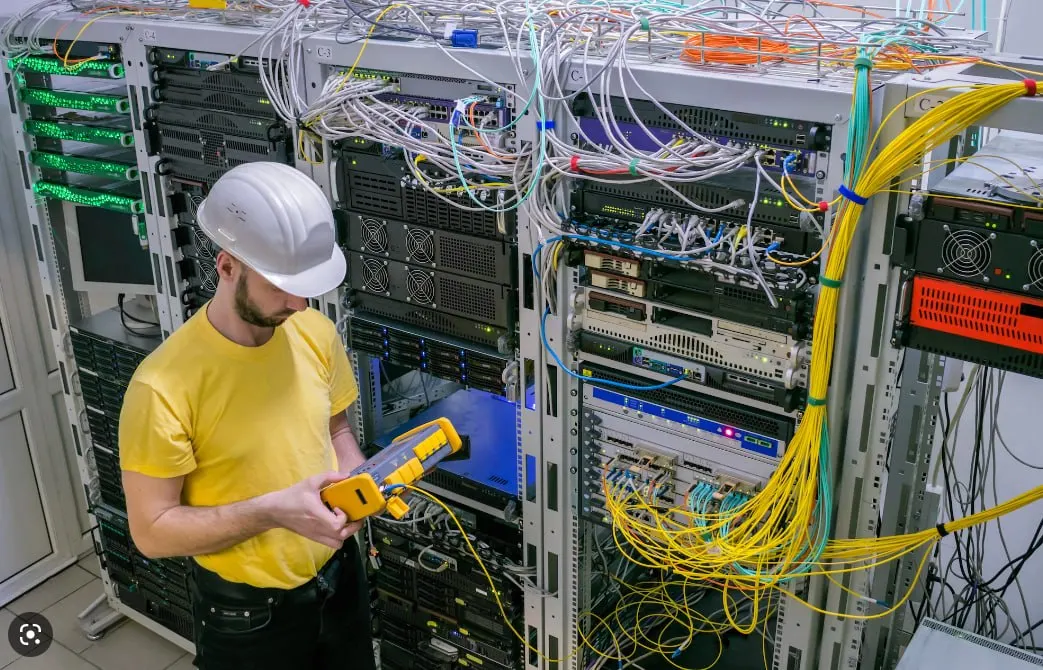
Fiber doesn't have that constraint. A single-mode fiber backbone can run several kilometers with minimal signal loss, which is exactly why it's the standard choice for connecting floors, buildings or separate sites on the same premises.
This is also the point where a proper site survey pays for itself. Rather than guessing at cable routes floor by floor, a survey maps the actual distances, distribution points and future growth so the backbone is sized correctly the first time — instead of needing a second, disruptive upgrade a year or two later.
4. You Rely Heavily on Cloud Tools and Video Calls
A business running most of its work through cloud software, shared drives and video conferencing is far more sensitive to network quality than one that mostly works offline. Every dropped call, laggy screen-share or slow file sync directly costs staff time — and it adds up quickly across a full team, every day.
This is one of the fastest-growing reasons Dubai businesses upgrade: the shift to cloud-first tools happened gradually, but the network supporting it often didn't scale alongside it.
Latency matters here as much as raw speed. A network can technically have "enough bandwidth" on paper and still feel sluggish in a video call if the connection is inconsistent — which is a common symptom of aging copper infrastructure carrying more traffic than it was originally designed for.
5. You're Planning to Add Bandwidth-Heavy Systems
CCTV with continuous recording, access control systems, VoIP phone systems and IoT sensors all add constant background load to a network, even when nobody's actively using them. Adding these to a network that's already near capacity is one of the most common ways an office network goes from "a bit slow" to "unusable" almost overnight.
Planning the network upgrade before adding these systems — rather than after problems start — is significantly cheaper and avoids reworking cabling that's already in place. This is often the final confirmation of the signs business needs fiber network solutions Dubai businesses should already be planning for.
Why Ignoring These Signs Costs More Than the Upgrade Would
A slow network rarely shows up as a single dramatic failure — it shows up as small, repeated friction: a few minutes lost here, a dropped call there, a file that has to be re-sent. None of that looks urgent enough to act on immediately, which is exactly why so many businesses run on a struggling network for far longer than they should.
Added up across a team over months, that friction usually costs more in lost time than a proper fiber upgrade would have cost outright — and unlike a slow network, a certified fiber installation is a one-time investment with documented performance, not an ongoing drag on productivity.
Recognized the Signs Business Needs Fiber Network Solutions Dubai? Here's What a Typical Upgrade Involves
A business fiber network upgrade in Dubai usually includes:
- A site survey and network design — mapping current and future bandwidth needs before any cable is pulled
- Structured cabling — single-mode fiber for backbone runs between floors or buildings, multi-mode or copper for shorter in-room runs
- Fusion splicing at every termination point for a low-loss, permanent connection
- OTDR-certified testing on every installed link before handover, with a documented trace report
Most single-site commercial installations are completed within a few days to a week, scheduled around business hours to minimize disruption. The core cabling uses standard structured cabling practices, so the network stays organized and easy to expand later rather than becoming another tangle to replace in a few years.
A key decision is how much of the office gets rewired. Many upgrades run a new fiber backbone to key distribution points on each floor and keep existing copper for short final-metre runs to individual desks — this fixes the main bottleneck without the cost or disruption of rewiring every workstation.
FAQs on Business Fiber Network Signs
How do I know if my business needs a fiber network upgrade?
The clearest signs business needs fiber network solutions Dubai wide include frequent slowdowns during peak use, regular connectivity drops, moving to a larger or multi-floor office, heavy reliance on cloud tools and video calls, and plans to add CCTV, access control or other bandwidth-heavy systems.
What does a business fiber network upgrade usually include?
A typical upgrade includes a site survey and network design, structured cabling with single-mode and/or multi-mode fiber, fusion splicing at each termination point, and OTDR-certified testing on every link before handover.
Is fiber only worth it for large offices?
No. Even small offices benefit once they depend on cloud software, video conferencing or connected security systems, since copper connections degrade faster over distance and under heavier daily use.
Does upgrading to fiber mean rewiring the whole office?
Not always. Many upgrades run a fiber backbone to key distribution points and keep existing copper for short final-metre runs, which limits disruption while still fixing the main bottleneck.
How long does a business fiber installation take?
Most single-site commercial installations are completed within a few days to a week, depending on cable runs and the number of termination points, and are scheduled to avoid disrupting business hours.
Can a fiber network support security systems like CCTV and access control?
Yes. Fiber is well suited to bandwidth-heavy systems like continuous CCTV recording, access control and IoT sensors, since it has far more headroom than copper and doesn't degrade under constant background load.
Spotted These Signs in Your Network?
Zane Wave handles fiber network projects end to end — site survey, structured cabling, fusion splicing and OTDR-certified testing on every link.
See Our Fiber Network Solutions Service