
UAE E-Invoicing POS System
- By Nimrah Shahid
- October 14, 2026
- POS System
UAE E-Invoicing POS System: What Retailers Must Know
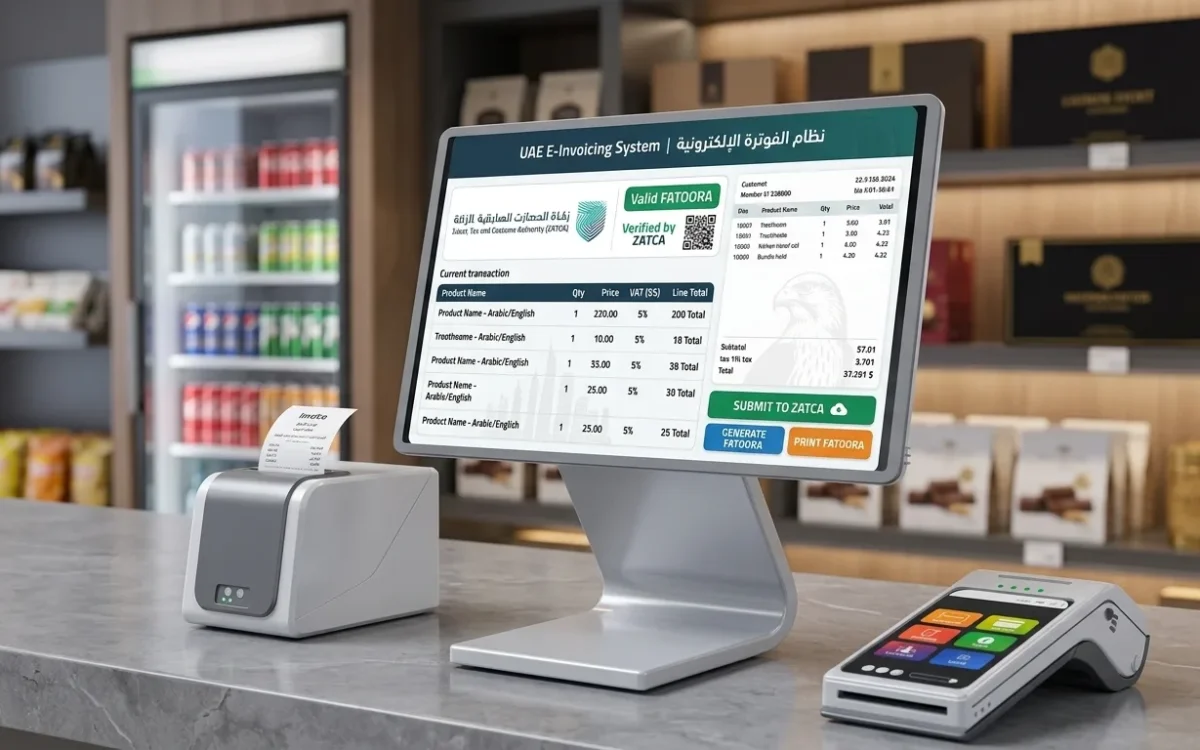
The UAE e-invoicing POS system question is coming up in almost every retail and restaurant conversation right now, because the first mandatory dates are close. The short answer is reassuring for most shops: sales to ordinary customers (B2C) are excluded from the mandate. The longer answer is that some businesses also sell to other companies from the same till, and those sales can be in scope. This guide explains the dates, who is affected and what to check with your POS provider.
This is general information, not tax advice. Always confirm your position with the Federal Tax Authority (FTA) or a tax adviser.
UAE e-invoicing POS system: the mandate covers B2B and B2G transactions, and B2C transactions are excluded under Article 4 of Ministerial Decision No. 243/2025. Businesses with revenue of AED 50 million or more must appoint an accredited service provider (ASP) by 30 October 2026 and go live on 1 January 2027; other in-scope businesses follow with an ASP deadline of 31 March 2027 and go-live on 1 July 2027. If your till only serves walk-in customers, your receipts are not affected, but check any business customers you invoice.
What UAE E-Invoicing Is
E-invoicing in the UAE means invoices are issued and exchanged in a structured electronic format through an accredited service provider (ASP), rather than as paper or an emailed PDF. The aim is for invoice data to move between businesses, and to the tax authority, in a standard form.
For a UAE e-invoicing POS system, it helps to know that e-invoicing is separate from the receipts your POS prints at the counter. A normal retail receipt to a walk-in customer is a B2C transaction, which is excluded from the mandatory scheme.
Key Dates
According to published summaries of the rules, the ASP appointment deadline for large businesses was extended from 31 July to 30 October 2026. The UAE e-invoicing POS system timeline is:
| Group | Appoint an ASP by | Mandatory from |
|---|---|---|
| Revenue of AED 50 million or more | 30 October 2026 | 1 January 2027 |
| Other in-scope businesses | 31 March 2027 | 1 July 2027 |
| Government entities | Not stated | 1 October 2027 |
These dates come from secondary sources. Check the latest position with the Ministry of Finance and the Federal Tax Authority before you plan around them.
Does It Apply to a Retail POS?
It depends on who you sell to. For a UAE e-invoicing POS system decision, split your sales into three groups:
- Walk-in customers (B2C): excluded from the mandate. Your normal till receipts continue as before.
- Business customers (B2B): in scope. If you issue tax invoices to companies, for example a trade account or a supplier-to-business sale, these may need to be issued as e-invoices.
- Government customers (B2G): in scope.
A café or boutique that only sells to the public is unlikely to be affected on the till. A wholesaler, a supermarket with trade accounts, or a shop that supplies offices should check carefully. Being in scope does not depend on being VAT-registered, according to published summaries, so do not assume a smaller business is exempt.
5 Things to Check on Your UAE E-Invoicing POS System
- Can it issue proper tax invoices? A tax invoice needs the supplier and customer details, TRN, date, description, VAT amount and total.
- Can it separate B2B from B2C sales? You need a way to tag sales to business customers so they can be handled differently.
- Does your software provider work with an ASP? Ask them directly how e-invoicing will be supported and whether it is included or an add-on.
- Can it export to your accounting software? Clean sales and VAT data makes invoicing and reporting much easier.
- Are your records kept long enough? UAE businesses are generally required to keep tax records for at least five years, so make sure your system can retrieve old sales.
Penalties Reported
For any UAE e-invoicing POS system, published summaries report penalties under Cabinet Decision No. 106 of 2025, including AED 5,000 for each month or part of a month of delay in implementing e-invoicing or appointing an ASP, and AED 100 per late e-invoice, capped at AED 5,000 per calendar month. Confirm current amounts with the FTA. The point for most small businesses is simple: find out early whether you are in scope, rather than after a deadline.
Where POS Installation Fits In
E-invoicing is mostly a software and data question, but a UAE e-invoicing POS system still depends on a stable hardware and network setup. If your terminals, printers, scanners and card terminals are old or poorly connected, sales data can be incomplete or delayed. A properly planned POS system installation Dubai covers the terminals, receipt printers, scanners, cash drawers, card terminal setup and the network points they rely on.
We install and set up POS hardware and can check your network readiness during the site survey. E-invoicing itself depends on your POS software and your accredited provider, so we recommend confirming that part with them. For multi-branch networks see our fiber network solutions, and for cash handling at the till see cash counting machine repair.
Frequently Asked Questions
Does UAE e-invoicing apply to my retail shop?
Under the UAE e-invoicing POS system rules, sales to walk-in customers (B2C) are excluded from the mandate. If you also invoice other businesses or government entities, those sales may be in scope. Confirm your position with the FTA or a tax adviser.
Do I need to change my POS system before 1 January 2027?
Not necessarily. For your UAE e-invoicing POS system, the 1 January 2027 date applies to businesses with revenue of AED 50 million or more. Other in-scope businesses have a later go-live of 1 July 2027. Ask your POS software provider how they will support e-invoicing for B2B sales.
Will my customers still get a printed receipt?
The mandate excludes B2C transactions, so ordinary receipts to walk-in customers continue as before. Keep your receipt printer and POS in good working order.
What is an ASP?
An ASP is an accredited service provider that sends and receives e-invoices on a business's behalf in the format required by the UAE system. Businesses in scope need to appoint one.
Is a VAT-registered business the only one affected?
No. According to published summaries, the requirement applies whether or not a business is VAT-registered, depending on the transaction. Check your own position.
Who can confirm the official rules?
The Ministry of Finance and the Federal Tax Authority publish the official requirements. We are not a tax adviser, so please confirm dates, scope and penalties with them.
Planning a New POS Setup?
Site survey available. We set up terminals, printers, scanners, cash drawers and card terminals for retail and restaurants.
Explore POS System Installation